

Una lectura desde la calidad, la postcosecha y el Pre-Harvest Shelf-Life Score® a partir del IBO Global Blueberry Report 2026
El IBO Global Blueberry Report 2026 confirma algo que la industria viene experimentando desde hace varios años: el arándano continúa creciendo a escala global, pero también está entrando en una etapa mucho más compleja.
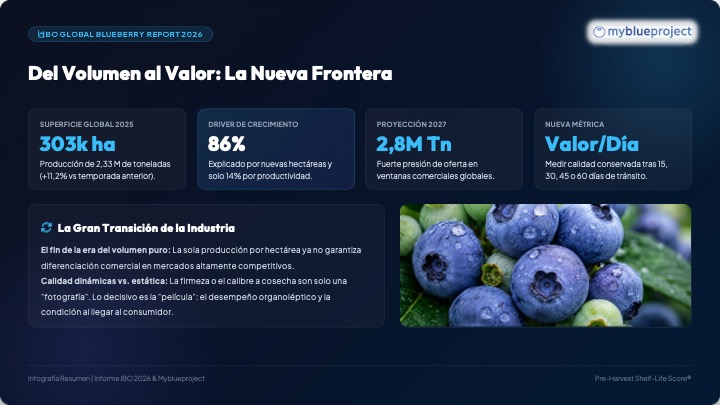
En 2025, la superficie mundial de arándanos cultivados alcanzó aproximadamente 303.000 hectáreas, con una producción de 2,33 millones de toneladas entre fruta fresca y procesada. La producción creció 11,2% respecto de la temporada anterior. El propio reporte proyecta que el volumen podría alcanzar al menos 2,6 millones de toneladas en 2026 y 2,8 millones en 2027.
Pero hay un dato que merece una lectura más profunda: de ese crecimiento de 2025, aproximadamente 86% se explicó por superficie que entró en producción y solamente 14% por incremento de productividad.
Esto nos plantea una pregunta que va mucho más allá del volumen:
¿Qué ocurrirá cuando una oferta global cada vez mayor compita por el mismo consumidor?
La respuesta probablemente no estará en producir simplemente más.
Estará en producir mejor y, sobre todo, entregar mejor.
Una industria que está cambiando su unidad de valor
Durante mucho tiempo, uno de los principales indicadores de éxito del negocio fue la capacidad de producir toneladas por hectárea.
Ese indicador sigue siendo fundamental para la economía de cualquier proyecto agrícola. Pero en una industria globalizada, con nuevas regiones entrando en producción y con ventanas comerciales que se superponen cada vez más, el volumen por sí solo comienza a perder capacidad de diferenciación.
El propio IBO señala que, a medida que Perú y otros orígenes continúan expandiendo su oferta, los premios estacionales pueden comprimirse, haciendo cada vez más importante diferenciarse mediante calidad varietal, oportunidad de cosecha y diversidad de mercados de destino.
Por lo tanto, la pregunta ya no debería ser solamente:
¿Cuánto podemos producir?
Sino:
¿Cuánto valor somos capaces de entregar después de 15, 30, 45 o 60 días de viaje y comercialización?
Ese cambio de perspectiva es fundamental.
Porque la fruta que sale del huerto es solamente el comienzo de la historia.
La genética ya está cambiando las reglas del juego
Uno de los aspectos más relevantes del reporte es la importancia que adquiere la renovación varietal.
El mensaje del IBO es claro: las nuevas genéticas, especialmente las southern highbush, están generando una oferta con mejores perfiles de sabor, apariencia, calibre y comportamiento postcosecha, y estos atributos comienzan a convertirse en parte de la expectativa normal del mercado.
Esto es particularmente importante porque significa que algunos atributos que durante años fueron utilizados como grandes diferenciadores están dejando de ser excepcionales.
La firmeza es probablemente el mejor ejemplo.
Durante décadas, hablar de calidad en arándanos significaba hablar de firmeza. Se buscaba una fruta firme porque esa firmeza estaba asociada a resistencia al manejo, transporte y almacenamiento.
Hoy, sin embargo, las nuevas generaciones varietales han avanzado significativamente en firmeza y calibre, además de incorporar atributos como crocancia, sabor, apariencia y potencial de vida comercial.
Esto no significa que debamos dejar de medir firmeza.
Todo lo contrario.
La firmeza continúa siendo un parámetro de referencia fundamental, porque permite comparar lotes, variedades, manejos y evolución durante la guarda.
Pero debemos dejar de confundir: firmeza = calidad.
La firmeza es ahora una parte de una ecuación mucho más grande.
Y aquí aparece uno de los grandes cambios que necesita la industria:
Pasar de medir atributos a medir desempeño.
Una fruta puede comenzar con una excelente firmeza y perder rápidamente agua, bloom o condición. Puede desarrollar Botrytis. Puede presentar daño mecánico. Puede cambiar su textura o desarrollar problemas de pulpa. Y, finalmente, puede no entregar la experiencia sensorial que el consumidor esperaba.
Por eso, la calidad no debería ser una fotografía tomada el día de cosecha. Debe ser una película.
Del “Shelf-Life” al potencial de Shelf-Life
Aquí es donde adquiere especial relevancia el concepto de Pre-Harvest Shelf-Life Score®.
Tradicionalmente hemos evaluado la vida postcosecha cuando la fruta ya está cosechada, embalada o incluso cuando llega a destino.
Pero si queremos gestionar calidad de manera estratégica, debemos comenzar mucho antes.
La pregunta debería ser:
¿Cuál es el potencial de vida comercial de esta fruta antes de cosecharla?
El Pre-Harvest Shelf-Life Score® propone precisamente cambiar esa lógica: evaluar, antes de la cosecha, aquellos factores que pueden determinar el comportamiento posterior de la fruta.
El objetivo no es reemplazar los parámetros tradicionales.
Es ponerlos en contexto.
La firmeza sigue siendo importante, pero debemos preguntarnos cuánto de esa firmeza se conserva.
El calibre sigue siendo importante, pero debemos preguntarnos si el tamaño viene acompañado de una buena experiencia de consumo.
El Brix sigue siendo importante, pero debemos entender que un valor alto no garantiza por sí solo sabor, textura ni aceptación.
Y una fruta visualmente perfecta al día cero no necesariamente será una fruta comercialmente exitosa al día 30.
El caso de Chile muestra el cambio
El reporte IBO entrega un ejemplo particularmente interesante.
Durante la temporada 2025-26, Chile registró cerca de 92.900 toneladas de exportaciones frescas. El crecimiento estuvo fuertemente relacionado con las nuevas variedades: el volumen de nuevas genéticas aumentó 14%, mientras que las variedades tradicionales continuaron perdiendo participación. Las nuevas variedades representaron 24% de las exportaciones, frente a 21% la temporada anterior.
Pero el dato más interesante está en la coexistencia de dos realidades.
Por un lado, las nuevas genéticas están impulsando una mejor experiencia de consumo.
Por otro, parte de la fruta tradicional que normalmente habría sido destinada a congelado terminó entrando al mercado fresco debido a las condiciones comerciales de la temporada, y el propio reporte reconoce que parte de esa fruta no llegó en una condición alineada con el objetivo de calidad de la industria chilena.
Esto demuestra algo fundamental:
No toda fruta que puede ser exportada debería necesariamente ser tratada como fruta fresca para cualquier destino.
La decisión debe considerar genética, condición, madurez, tránsito, mercado y expectativa del consumidor.
Perú: el volumen ya no es la única conversación
Perú representa uno de los ejemplos más claros de la transformación de la industria.
El crecimiento de su superficie ha sido extraordinario, pasando de unas 6.000 hectáreas en los primeros años de expansión a más de 30.000 hectáreas plantadas reportadas para 2025/26.
Pero el verdadero desafío de Perú —y de cualquier origen que siga creciendo— será transformar esa escala productiva en consistencia comercial.
El modelo que funcionó para conquistar mercados no necesariamente será suficiente para sostenerlos cuando la oferta global aumente.
La ventaja ya no será solamente producir en una ventana determinada.
Será poder decir:
“Sé qué fruta estoy produciendo, para qué mercado es adecuada, cuánto tiempo puede viajar y qué condición tendrá cuando llegue.”
Eso requiere información. Y requiere conectar los datos de campo con los datos de destino.
Marruecos y Europa: cuando la ventaja está en la ventana, la calidad y la consistencia
El caso de Marruecos también resulta especialmente interesante dentro de esta transformación de la industria.
El crecimiento de las zonas de bajo requerimiento de frío —entre ellas Marruecos— ha contribuido de manera importante a la expansión global del arándano. Pero el desafío para estos orígenes ya no es únicamente entrar temprano al mercado o aumentar superficie. A medida que más fruta está disponible durante las mismas ventanas comerciales, la diferenciación pasa por la capacidad de entregar una experiencia consistente al consumidor.
Marruecos tiene además una posición estratégica frente al mercado europeo por proximidad y por su capacidad para abastecer determinadas ventanas de producción. Esto reduce, en determinados circuitos, la distancia entre origen y consumidor y puede convertirse en una ventaja importante para conservar calidad.
Pero la proximidad geográfica no garantiza por sí sola una mejor fruta.
El verdadero desafío está en convertir esa ventaja logística en vida comercial y experiencia de consumo: mantener firmeza, reducir deshidratación, conservar bloom, controlar Botrytis y evitar que la fruta llegue con una condición de madurez que limite su permanencia en el mercado.
Europa, por su parte, representa un mercado particularmente interesante para observar esta evolución. El crecimiento de la oferta no significa necesariamente que todos los productos compitan bajo las mismas condiciones. La variedad, la ventana de producción, el origen, el tránsito y la condición de llegada pueden generar diferencias importantes en valor.
El propio comportamiento de España muestra esta transición. El aumento de las exportaciones ha estado acompañado por una renovación varietal orientada no solamente a productividad, sino también a características valoradas por el mercado, como sabor, calibre, firmeza y vida comercial.
Esto es relevante porque demuestra que la genética está evolucionando hacia un paquete de atributos, y no hacia una única característica.
La pregunta, entonces, deja de ser: ¿Cuánta fruta podemos producir?
Y empieza a ser:
¿Qué fruta podemos producir, para qué mercado, en qué ventana y con qué desempeño hasta el consumidor?
En este contexto, Marruecos y Europa representan muy bien una nueva lógica competitiva: la proximidad, la ventana comercial y la genética pueden generar una ventaja, pero esa ventaja solo se transforma en valor cuando la calidad se conserva durante toda la cadena.
De la firmeza al desempeño
Aquí aparece nuevamente un punto que considero fundamental.
Durante años, la firmeza fue uno de los principales indicadores para hablar de calidad en arándanos. Y debe seguir midiéndose. Es un parámetro objetivo, comparable y fundamental para evaluar condición de fruta.
Pero la evolución genética está cambiando esta ecuación.
Las nuevas variedades han mejorado de manera importante atributos como firmeza, calibre, sabor y vida comercial. El propio IBO señala que las nuevas genéticas están elevando el estándar de la oferta y que características que antes podían considerarse excepcionales están convirtiéndose progresivamente en un nuevo estándar comercial.
Por eso, la firmeza no pierde relevancia; cambia su rol.
Ya no debería ser interpretada como sinónimo de calidad, sino como uno de los indicadores de referencia dentro de un sistema mucho más amplio.
Una fruta puede presentar una excelente firmeza a cosecha y, sin embargo, perder rápidamente peso, bloom, textura, condición de pulpa o aceptación sensorial.
La verdadera pregunta es cuánto de ese potencial permanece cuando la fruta llega al consumidor.
Y ahí es donde necesitamos pasar de medir atributos a medir desempeño.
Una nueva unidad de valor
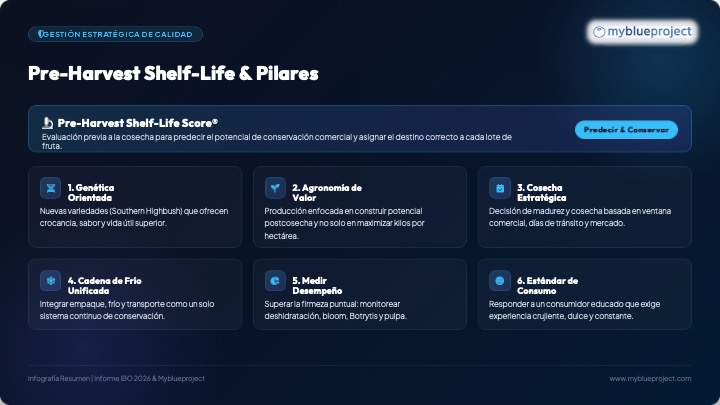
El desafío de la próxima etapa de la industria será conectar genética, manejo agronómico, madurez, cosecha, enfriamiento, cadena de frío, tránsito, mercado y consumidor.
Es precisamente en esa conexión donde el Pre-Harvest Shelf-Life Score® puede aportar una nueva mirada: evaluar antes de cosecha cuánto potencial tiene una fruta para sostener la calidad que el mercado necesita.
Porque si sabemos que una determinada genética puede entregar firmeza y calibre superiores, la pregunta ya no es solamente cuánto marca el FirmPro el día de cosecha.
La pregunta es:
¿Qué pasará con esa fruta después de 30, 45 o más días?
¿Qué porcentaje de firmeza conservará?
¿Cuánto peso habrá perdido?
¿Mantendrá el bloom?
¿Habrá Botrytis?
¿Cómo evolucionará la pulpa?
¿Seguirá siendo atractiva y agradable para el consumidor?
Ese cambio de perspectiva es, en mi opinión, una de las grandes oportunidades de la industria.
La calidad del futuro no será solamente la calidad que somos capaces de producir. Será la calidad que somos capaces de predecir, conservar y entregar.
La cadena de frío deja de ser una operación y pasa a ser parte de la calidad
Una buena genética no puede compensar una mala cadena postcosecha.
Y una excelente cadena de frío tampoco puede convertir una fruta que no tenía potencial de guarda en una fruta de larga vida comercial.
La calidad final es consecuencia de la interacción entre ambos factores.
Por eso debemos dejar de analizar: ; Genética; Agronomía; Cosecha; Packing; Frío: Transporte; Destino como compartimentos independientes.
Son partes de un mismo sistema.
Una fruta con alto potencial de shelf-life necesita ser acompañada por una cadena capaz de conservar ese potencial.
De lo contrario, la inversión genética y agronómica se pierde durante el viaje.
El mercado también está elevando el estándar
El IBO observa que el benchmark de calidad se está moviendo rápidamente: variedades que hace algunos años eran consideradas excepcionales están comenzando a convertirse en estándar a medida que nuevas genéticas llegan al mercado. El reporte advierte que esto es positivo para los consumidores, pero también aumenta la presión sobre productores que no logren mantener el ritmo.
Este punto es crítico.
La industria no compite solamente contra otras empresas.
Compite contra la expectativa que ella misma ha creado.
Si el consumidor aprende a reconocer un arándano crujiente, dulce, grande, firme y consistente, esa experiencia se transforma en el nuevo estándar.
La próxima compra ya no se compara necesariamente con la fruta de ayer.
Se compara con la mejor fruta que el consumidor probó recientemente.
¿Qué necesita una industria que quiere competir por calidad y no solamente por volumen?
Creo que debemos comenzar a hablar de al menos seis pilares.
1. Genética orientada al mercado
No existe una variedad perfecta para todos los mercados.
La genética debe evaluarse considerando ventana productiva, condición climática, destino, tránsito, vida comercial y experiencia de consumo.
2. Producción orientada a construir calidad
El objetivo agronómico no puede ser solamente maximizar kilos.
Debe ser producir fruta con el potencial correcto para el mercado al que será destinada.
3. Madurez y cosecha como decisiones estratégicas
No toda fruta debe cosecharse bajo el mismo criterio.
La madurez debe interpretarse en función de genética, destino y tiempo de tránsito.
4. Pre-Harvest Shelf-Life Score®
Necesitamos herramientas que permitan anticipar el comportamiento poscosecha antes de comprometer fruta con un mercado.
No solamente preguntar:
¿Cómo está la fruta hoy?
Sino:
¿Qué probabilidad tiene de llegar bien después del viaje que le estamos pidiendo realizar?
5. Cadena postcosecha diseñada para conservar el potencial
Enfriamiento, temperatura, humedad, manipulación, embalaje, transporte y almacenamiento deben funcionar como un sistema.
6. Feedback real desde destino
El dato más valioso no necesariamente está en el packing.
Muchas veces está en el supermercado.
La información de firmeza, pérdida de peso, bloom, Botrytis, pulpa, sabor y aceptación debe regresar al productor para convertirse en una herramienta de aprendizaje.
La nueva unidad de valor
Tal vez uno de los mayores cambios que necesita nuestra industria sea redefinir qué entendemos por productividad.
Durante años: Productividad = kg/ha
En una industria orientada a calidad, deberíamos comenzar a pensar en algo diferente:
Valor comercial = volumen × calidad × vida comercial × consistencia × experiencia de consumo
No se trata de producir menos.
Se trata de producir con propósito.
Porque una fruta que produce más kilos pero genera más reclamos, mayor descarte o una mala experiencia de consumo no necesariamente genera más valor.
El futuro: una industria más predictiva
El propio IBO identifica que el crecimiento de la industria está generando un ecosistema de innovación cada vez más sofisticado: nuevas genéticas, cosecha mecanizada para fresco, tecnologías de selección y preselección, inteligencia artificial aplicada a pronósticos, madurez y evaluación de calidad, nuevas soluciones de polinización y herramientas biológicas.
Esto abre una oportunidad enorme.
La industria puede pasar de una lógica predominantemente reactiva:
“Evaluamos la fruta y vemos qué ocurrió.”
a una lógica predictiva:
“Medimos las variables críticas y anticipamos qué puede ocurrir.”
Ese es, en mi opinión, uno de los grandes desafíos de la próxima década.
De producir más a entregar mejor
El IBO Global Blueberry Report 2026 muestra una industria que continuará creciendo.
Pero también muestra una industria donde la genética está elevando rápidamente el estándar, donde aparecen nuevos competidores, donde los mercados se vuelven más sofisticados y donde los costos de producir y mover fruta son cada vez más relevantes.
En este escenario, la ventaja competitiva no estará solamente en las hectáreas.
Tampoco estará solamente en las toneladas.
Y probablemente ni siquiera estará solamente en tener una variedad más firme o más grande.
La próxima ventaja competitiva estará en la capacidad de predecir, construir y conservar la calidad.
La firmeza seguirá midiéndose.
El calibre seguirá midiéndose.
El Brix seguirá midiéndose.
La condición seguirá midiéndose.
Pero el verdadero desafío será entender cómo todos esos atributos interactúan y cómo evolucionan durante el viaje hasta el consumidor.
Porque la pregunta más importante ya no es:
¿Qué calidad tiene esta fruta hoy?
Sino:
¿Qué calidad será capaz de entregar mañana?
Y esa respuesta comienza mucho antes de la postcosecha :Comienza en el campo.
From Volume to Value: The New Quality Frontier in the Blueberry Industry
A reading on quality, postharvest, and the Pre-Harvest Shelf-Life Score® based on the IBO Global Blueberry Report 2026
The IBO Global Blueberry Report 2026 confirms something that the industry has been experiencing for several years: blueberries continue to grow on a global scale, but they are also entering a much more complex phase.
In 2025, the global cultivated blueberry area reached approximately 303,000 hectares, with a production of 2.33 million metric tons between fresh and processed fruit. Production grew by 11.2% compared to the previous season. The report itself projects that volume could reach at least 2.6 million tons in 2026 and 2.8 million in 2027.
However, there is a data point that deserves a deeper reading: of that growth in 2025, approximately 86% was explained by new acreage entering into production, and only 14% came from productivity increases.
This raises a question that goes far beyond volume:
| What will happen when an increasingly larger global supply competes for the exact same consumer? |
The answer will likely not lie in simply producing more. It will lie in producing better and, above all, delivering better.
An Industry Changing Its Unit of Value
For a long time, one of the main indicators of business success was the ability to produce tons per hectare. That indicator remains fundamental to the economics of any agricultural project. But in a globalized industry, with new regions entering production and commercial windows increasingly overlapping, volume alone begins to lose its power of differentiation.
The IBO itself points out that, as Peru and other origins continue to expand their supply, seasonal premiums may compress, making it increasingly vital to differentiate through varietal quality, harvest timing, and target market diversity.
Therefore, the question should no longer be solely:
| How much can we produce?
Rather: How much value are we capable of delivering after 15, 30, 45, or 60 days of travel and marketing? |
This shift in perspective is fundamental. Because the fruit that leaves the orchard is only the beginning of the story.
Genetics is Already Changing the Rules of the Game
One of the most relevant aspects of the report is the importance placed on varietal renewal. The IBO’s message is clear: new genetics, particularly southern highbush, are generating a supply with better flavor profiles, appearance, size, and postharvest performance—and these attributes are beginning to become part of normal market expectations.
This is particularly important because it means that certain attributes used for years as major differentiators are ceasing to be exceptional.
Firmness is probably the best example. For decades, talking about quality in blueberries meant talking about firmness. Firm fruit was sought after because firmness was associated with resistance to handling, transport, and storage.
Today, however, new varietal generations have made significant strides in firmness and size, while also incorporating attributes such as crunchiness, flavor, appearance, and shelf-life potential.
This does not mean we should stop measuring firmness. Quite the contrary. Firmness remains a fundamental benchmark parameter because it allows for the comparison of lots, varieties, management practices, and evolution during storage.
But we must stop confusing: firmness = quality. Firmness is now just one part of a much larger equation.
And here lies one of the major shifts the industry needs: moving from measuring attributes to measuring performance.
A fruit can start with excellent firmness and quickly lose water, bloom, or condition. It can develop Botrytis. It can suffer mechanical damage. Its texture can change or develop internal pulp issues. And ultimately, it may fail to deliver the sensory experience the consumer expected.
That is why quality should not be a photograph taken on harvest day. It must be a movie.
From «Shelf-Life» to Shelf-Life Potential
This is where the concept of the Pre-Harvest Shelf-Life Score® takes on special relevance. Traditionally, we have evaluated postharvest life once the fruit is already harvested, packed, or even when it arrives at destination. But if we want to manage quality strategically, we must start much earlier.
The question should be: What is the commercial life potential of this fruit before harvesting it?
The Pre-Harvest Shelf-Life Score® proposes precisely changing that logic: evaluating, before harvest, those factors that can determine the subsequent behavior of the fruit. The goal is not to replace traditional parameters; it is to put them into context.
- Firmness remains important, but we must ask how much of that firmness is retained.
- Size remains important, but we must ask whether the size is accompanied by a good eating experience.
- Brix remains important, but we must understand that a high value does not single-handedly guarantee flavor, texture, or consumer acceptance.
And a visually perfect fruit on day zero will not necessarily be a commercially successful fruit on day 30.
The Case of Chile Shows the Shift
The IBO report provides a particularly interesting example. During the 2025-26 season, Chile recorded nearly 92,900 metric tons of fresh exports. Growth was strongly tied to new varieties: the volume of new genetics increased by 14%, while traditional varieties continued to lose market share. New varieties represented 24% of exports, compared to 21% the previous season.
However, the most interesting data point lies in the coexistence of two realities. On one hand, new genetics are driving a better consumer experience. On the other, part of the traditional fruit normally destined for freezing ended up entering the fresh market due to seasonal commercial conditions, and the report itself recognizes that part of that fruit did not arrive in a condition aligned with the quality objective of the Chilean industry.
This demonstrates something fundamental: not all fruit that can be exported should necessarily be treated as fresh fruit for any destination. The decision must consider genetics, condition, maturity, transit, market, and consumer expectations.
Peru: Volume is No Longer the Only Conversation
Peru represents one of the clearest examples of industry transformation. The growth of its cultivated area has been extraordinary, expanding from around 6,000 hectares in the early years of expansion to more than 30,000 planted hectares reported for 2025/26.
However, Peru’s true challenge—and that of any origin that continues to grow—will be transforming that productive scale into commercial consistency. The model that worked to conquer markets will not necessarily be sufficient to sustain them as global supply increases.
The advantage will no longer be merely producing in a given window. It will be being able to say: «I know what fruit I am producing, which market it is suitable for, how long it can travel, and what condition it will have when it arrives.»
That requires information. And it requires connecting field data with destination data.
Morocco and Europe: When the Advantage Lies in Window, Quality, and Consistency
The case of Morocco is also particularly interesting within this industry transformation. The growth of low-chill requirement zones—including Morocco—has contributed significantly to the global expansion of blueberries. However, the challenge for these origins is no longer solely entering the market early or expanding acreage. As more fruit becomes available during the same commercial windows, differentiation comes down to the ability to deliver a consistent consumer experience.
Furthermore, Morocco holds a strategic position relative to the European market due to proximity and its ability to supply specific production windows. In certain supply loops, this reduces the distance between origin and consumer, which can become a major advantage for preserving quality.
Yet geographic proximity alone does not guarantee better fruit. The real challenge lies in translating that logistical advantage into shelf life and eating quality: maintaining firmness, reducing dehydration, preserving bloom, controlling Botrytis, and preventing fruit from arriving at a maturity stage that limits its market longevity.
Europe, for its part, represents a particularly interesting market to observe this evolution. Growing supply does not necessarily mean that all products compete under the same conditions. Variety, production window, origin, transit, and arrival condition can create significant value gaps.
Spain’s own behavior illustrates this transition. Increasing exports have been accompanied by varietal renewal aimed not only at productivity, but also at attributes valued by the market, such as flavor, size, firmness, and shelf life. This is relevant because it demonstrates that genetics is evolving toward a complete package of attributes, rather than a single feature.
The question, then, ceases to be: How much fruit can we produce? And starts to be: What fruit can we produce, for which market, in which window, and with what performance through to the consumer?
In this context, Morocco and Europe clearly exemplify a new competitive logic: proximity, commercial window, and genetics can generate an advantage, but that advantage only turns into value when quality is preserved throughout the entire chain.
From Firmness to Performance
Here again appears a point I consider fundamental. For years, firmness was one of the main indicators for quality in blueberries. And it must continue to be measured. It is an objective, comparable, and fundamental parameter for evaluating fruit condition.
However, genetic evolution is changing this equation. New varieties have significantly improved attributes such as firmness, size, flavor, and shelf life. The IBO itself notes that new genetics are raising the standard of supply and that characteristics previously considered exceptional are progressively becoming the new commercial baseline.
Therefore, firmness does not lose relevance; it changes its role. It should no longer be interpreted as a synonym for quality, but as one reference indicator within a much broader system.
A fruit can exhibit excellent firmness at harvest and yet quickly lose weight, bloom, texture, pulp condition, or sensory acceptance. The real question is how much of that potential remains when the fruit reaches the consumer.
And that is where we need to move from measuring attributes to measuring performance.
A New Unit of Value
The challenge of the industry’s next phase will be connecting genetics, agronomic management, maturity, harvest, cooling, cold chain, transit, market, and consumer. It is precisely in that connection where the Pre-Harvest Shelf-Life Score® can provide a fresh perspective: evaluating, prior to harvest, how much potential a fruit has to sustain the quality the market demands.
Because if we know that a given genetic line can deliver superior firmness and size, the question is no longer just what the FirmPro reads on harvest day. The question is: What will happen to that fruit after 30, 45, or more days?
- Firmness Retention: What percentage of firmness will it retain?
- Weight Loss: How much weight will it have lost?
- Appearance & Health: Will it maintain its bloom? Will Botrytis appear? How will the internal pulp evolve?
- Sensory Appeal: Will it remain attractive and enjoyable for the consumer?
This change in perspective is, in my view, one of the greatest opportunities for the industry. Future quality will not merely be the quality we are capable of producing. It will be the quality we are capable of predicting, preserving, and delivering.
The Cold Chain Is No Longer Just Operations — It Is Part of Quality
Good genetics cannot compensate for a poor postharvest chain. Nor can an excellent cold chain transform fruit that lacked storage potential into fruit with a long commercial life. Final quality is the direct consequence of the interaction between both factors.
That is why we must stop analyzing Genetics, Agronomy, Harvest, Packing, Cold Storage, Transport, and Destination as independent silos. They are parts of the exact same system.
Fruit with high shelf-life potential needs to be accompanied by a chain capable of preserving that potential. Otherwise, the genetic and agronomic investment is lost during transit.
The Market Is Also Raising the Standard
The IBO observes that the quality benchmark is moving rapidly: varieties that were considered exceptional a few years ago are starting to become standard as new genetics enter the market. The report warns that while this is positive for consumers, it also increases pressure on growers who fail to keep pace.
This point is critical. The industry does not compete solely against other companies; it competes against the expectations it has created itself.
If consumers learn to recognize a crunchy, sweet, large, firm, and consistent blueberry, that experience becomes the new standard. Their next purchase is not necessarily compared to yesterday’s fruit; it is compared to the best fruit they recently tasted.
What Does an Industry Need to Compete on Quality and Not Just Volume?
I believe we must begin talking about at least six key pillars:
- Market-Oriented Genetics: There is no single perfect variety for all markets. Genetics must be evaluated considering the production window, climate conditions, destination, transit time, shelf life, and sensory experience.
- Production Focused on Building Quality: The agronomic goal cannot be solely maximizing kilograms. It must be producing fruit with the right potential for its intended destination market.
- Maturity and Harvest as Strategic Decisions: Not all fruit should be harvested under the same criteria. Maturity must be interpreted in light of genetics, destination, and transit duration.
- Pre-Harvest Shelf-Life Score®: We need tools that allow us to anticipate postharvest behavior before committing fruit to a market. Not just asking «How is the fruit today?», but rather «What is the probability of it arriving in good condition after the journey we are asking it to make?»
- Postharvest Chain Designed to Preserve Potential: Cooling, temperature, humidity, handling, packaging, transport, and storage must function as a single integrated system.
- Real Feedback from Destination: The most valuable data is not necessarily at the packing house—it is often at the supermarket. Information on firmness, weight loss, bloom, Botrytis, pulp condition, flavor, and consumer acceptance must return to the grower to serve as a learning tool.
The New Metric of Commercial Value
Perhaps one of the biggest changes our industry needs is redefining what we understand by productivity.
For years: Productive Efficiency = kg / ha
In a quality-oriented industry, we should begin thinking differently:
|
Commercial Value = Volume × Quality × Shelf-Life × Consistency × Consumer Experience |
It is not about producing less; it is about producing with purpose. Fruit that produces more kilograms but generates more claims, higher rejection rates, or a poor consumer experience does not necessarily yield higher value.
The Future: A More Predictive Industry
The IBO itself identifies that industry growth is generating an increasingly sophisticated innovation ecosystem: new genetics, mechanized harvesting for fresh markets, sorting and pre-sorting technologies, artificial intelligence applied to forecasting, maturity, and quality assessment, new pollination solutions, and biological tools.
This opens up a massive opportunity. The industry can shift from a predominantly reactive logic («We inspect the fruit and see what happened») to a predictive logic («We measure critical variables and anticipate what might happen»).
That is, in my opinion, one of the greatest challenges of the coming decade.
From Producing More to Delivering Better
The IBO Global Blueberry Report 2026 shows an industry that will continue to grow. But it also shows an industry where genetics is rapidly raising the standard, where new competitors are emerging, where markets are becoming more sophisticated, and where the costs of producing and moving fruit are increasingly significant.
In this scenario, competitive advantage will not reside solely in hectares, nor in tonnage, and probably not even in merely owning a firmer or larger variety.
The next competitive advantage will lie in the ability to predict, build, and preserve quality.
Firmness will continue to be measured. Size will continue to be measured. Brix will continue to be measured. Condition will continue to be measured.
But the true challenge will be understanding how all these attributes interact and evolve during the journey to the consumer.
Because the most important question is no longer: What quality does this fruit have today?
Rather: What quality will it be able to deliver tomorrow?
|
And that answer begins long before postharvest: it begins in the field. |