
First Report of Diaporthe australafricanaAssociated with Stem Canker on Blueberry in Chile
Stem cankers of blueberry (Vaccinium corymbosum L.) have been observed on as much as 15% of the plants in plantations in central and southern Chile since 2006. Symptoms consisted of apical necrosis of the shoots and brown-to-reddish necrotic lesions on the stems
Canker and Twig Dieback of Blueberry Caused by Pestalotiopsis spp. and a Truncatella sp. in Chile
Blueberry (Vaccinium spp.) has great economic importance in Chile, which currently has about 8,500 ha being cultivated. Recently, the presence of canker and dieback symptoms has been observed along the productive blueberry zone of Chile. Species of Pestalotiopsis and Truncatella were consistently isolated from diseased samples in 22 different locations. Therefore, the objec- tive of this study was to identify and characterize the species of Pestalotiopsis and Truncatella associated with canker and twig dieback symptoms on blueberry. Forty-nine isolates were ob- tained on acidified potato dextrose agar in 2006 and 2007. These isolates were identified as Pestalotiopsis clavispora, P. neglecta, and Truncatella (=Pestalotia) angustata on the basis of colony characteristics and conidial morphology. This identification was verified by internal tran- scribed spacer analysis of DNA. Isolates of P. clavispora, P. neglecta, and T. angustata were pathogenic on apple, kiwifruit, and blueberry fruit. Similarly, isolates of P. clavispora were pathogenic on detached blueberry twigs of cv. O’Neal. Additionally, three selected isolates of P. clavispora induced light-brown canker lesions, surrounded by a reddish halo, and shoot dieback after twig inoculations on 2-year-old twigs of blueberry cvs. O’Neal, Bluecrop, Brightwell, Brigitta, Duke, Elliot, and Misty. Among blueberry cultivars, Brightwell and O’Neal were the most susceptible and Bluecrop and Misty the least susceptible, while Elliot, Brigitta, and Duke were moderately susceptible to P. clavispora. These pathogens were isolated consistently from inoculated plants, confirming Koch’s postulates. P. clavispora was highly sensitive to fludioxonil and pyraclostrobin with a median effective concentration of 0.06 to 0.08 and 0.04 to 0.8 μg/ml, respectively. Therefore, the results of this study indicate that P. clavispora, P. neglecta, and T. angustata are primary pathogens that can cause canker lesions and dieback symptoms on blue- berry not previously described in Chile. However, these results do not exclude that other species of these genera or other plant-pathogenic fungi (e.g., Botryosphaeria, Pestalotia, and Phomopsis spp.) may eventually be involved in this syndrome of blueberry.
Neofusicoccum spp. Associated with Stem Canker and Dieback of Blueberry in Chile
Blueberry (Vaccinium spp.) plantings have significantly increased in Chile during the last decade and, currently, over 10,700 ha are cultivated throughout the country. Among other diseases, stem canker and dieback has been frequently observed in commercial plantations with incidences between 15 and 45%. The aim of this study was to identify and characterize Neofusicoccum spp. causing stem canker and dieback of blueberry in Chile. Three species, N. arbuti, N. australe, and N. parvum, were identified based on colony and conidia morphology, and nucleotide sequence analysis of the internal transcribed spacer (ITS) region (ITS1-5.8S-ITS2). These Neofusicoccum spp. were found alone or coexisting with Pestalotiopsis spp., Truncatella spp., or Phomopsis spp. Koch’s postulates showed all Neofusicoccum spp. isolated from infected plants to be pathogenic when inoculated on blueberry fruit and twigs using both mycelia and conidia suspension. All blueberry cultivars tested, including, Brigitta, Bluecrop, Brightwell, Duke, Elliott, Misty, and O’Neal, were susceptible to Neofusicoccum spp. infection. Pathogenicity tests showed N. par- vum to be the most virulent species and Elliott to be the most susceptible cultivar. This report represents the first description of N. arbuti, N. australe, and N. parvum as canker-causing agents on blueberry in Chile.
First Report of Fusarium oxysporum Causing Fusarium Wilt on Blueberry (Vaccinium corymbosum) in Chile
E. A. Moya-Elizondo, H. Doussoulin, J. San Martin, B. Ruiz, and P. Del Valle Chile is the main exporter of blueberries in the Southern Hemisphere, producing this fruit from October to April each year, when there is no production available in the main markets situated in the northern hemisphere. In Chile, approximately 15,600 ha is […]
Plant Physiology Short Course
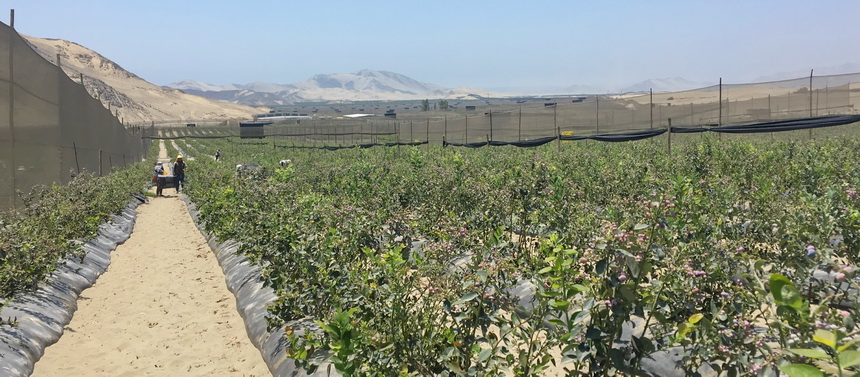
La fisiología vegetal, es el área de las ciencias biológicas dedicadas al estudio de los procesos metabólicos de las plantas, es muy importante conocer los conceptos básicos, ya que ellos contribuyen a que nuestra planta esté bien nutrida, sana y por lo tanto eso se va a traducir finalmente en un fruto de buena calidad con una mejor postcosecha.
First report of Fusarium oxysporum Schltdl causing Fusarium Wilt on blueberry (Vaccinium corymbosum L.) in Chile
Chile is the main exporter of blueberries in the Southern Hemisphere, producing this fruit from October to April each year, when there is no production available in the main markets situated in the northern hemisphere. Chile, with around 15,600 hectares planted with Highbush blueberries along the country, has some crown and root rot diseases, which affect the crops reducing its productivity (Larach et al., 2009).